Video Below: These electronic bug killers have been around for some time in various configurations. They first appeared as a smaller paddle and several were made in this country. Now, they are bigger and cheaper, and made in China. And, with the lower cost comes some cautionary suggestions. Despite the fact that it is fun to electrocute nasty flies and other pests, these bug zappers are not toys. They can be dangerous and particularly for children and anyone with a heart condition. These devices are high voltage, low amperage circuits that are poorly made and can provide unexpected and unpleasant shocks. Trust me on this fact! I have taken several of these apart and the circuits vary, but the soldering is very shoddy. If you want more information search for "voltage doublers" or "electronic bug zapper circuits". I have posted photos of some of the high voltage boards and one of the flash tube camera flash. But as a final note, please exercise caution and also avoid destroying the pollinators like bees and other beneficial flying critters. We have already lost too many. And now, on to the video:
Video Below: Thermochromic materials are those chemicals that exhibit a color change with temperature. The two best known methods of temperature induced color change involve either liquid crystals or leuco dyes. And, although there are inorganic compounds like titanium dioxide and zinc oxide that show color change with high heat, they fail to be useful as consumer products. A good example of liquid crystal color change is in the “mood ring” which was popular in the 1970’s and is still sold today. These rings are based on cholesteric liquid crystals that change color in the range of temperatures found in the human body. When I was actively involved in chemistry I was able to develop a method of detecting breast cancer with these materials. The technology was based on the fact that cancer cell colonies are warmer than the surrounding tissue and could be seen as hot spots. But, mammography was being developed that was much better than my crude approach. But, the chemical reactions in this video are based on leuco dyes. These are chemicals that have two distinct color phases. The color change can be triggered by pH, solvent action, or other chemical mechanism. A good example is that of crystal violet lactone, a leuco dye. If it is blended in a microcapsule with dodeconal, a solid alcohol with a low melting point, the alcohol will liquefy, protonate the lactone causing a change in pH, and that will result in a color shift. However, this is a bit of a misnomer as color change due to pH is actually called halochromism! But convention and culture continues to call it thermochromism. The advantage of these chemicals is that a wide range of temperatures can be fabricated with this technology. The two that are demonstrated in the video are triggered at 86 Fahrenheit. I bought these at Solar Color Dust but there are a number of suppliers that can be located by searching “thermochromic pigments”. They are a bit expensive but still interesting to work with. Enjoy…
This is a bit of a departure for me in that it is rare to go this far back in time. It is a video sponsored by Chevrolet in 1940 and it is essentially selling the 'NEW" light technology. But what I found interesting is the discussion about ultraviolet and infrared light that was just on the cutting edge of technology. What you will find is the the fact that there are corrections to be made based on a look in the rear view mirror but still entertaining. It is also politically incorrect but not for 1940. Sometimes a look back gives us an appreciation for what seems new and relevant. The video is from the Prelinger Video Archive and is in the public domain. Enjoy a look at the past!
Left, Castor bean (Ricinus communis). Originally from East Africa it is now found worldwide in warm climates, and has been used in medicine, dyeing, printing, and as a lubricant. This bean also produces ricin, a deadly toxin. Photo from Brian Prechtel, Agriculture Research Service. Right, the flowering plant photo from the United States Department of Agriculture.
Periodically we hear the term “Ricin”, generally in the context of this material being sent to someone via the mail. It is normally sent as a white powder in a sealed envelope with the intent to harm or kill the recipient. First the good news; statistically, the odds of any individual receiving this powder is incredibly low. It is most lethal when injected, but can be a serious poison when inhaled. It appears to be less potent when delivered as a contact poison but it is a material of consequence. Workers picking castor beans primarily in China and India frequently experience illness by contact. The bad news is that ricin is relatively easy to make and can be extracted from castor beans which are widely available. The LD50 is also very low. (LD is Median Lethal Dosage). The term refers to the amount necessary to kill 50% of the test subjects, typically mice. In the case of ricin, the dose is 22 micrograms per 1 kilogram (2.2 pounds) of adult weight. So, it takes very little to be fatal. I was going to go into the chemistry of ricin production but have reconsidered and want to provide only information about ricin and not a guide to isolate it. There are many good articles concerning this poison and I will leave it to our readers to pursue any additional information. One final thought is that castor oil that is made from that same castor bean does not contain ricin. The ricin is destroyed by the denaturing process in the manufacture of the oil. And, ricin has been investigated in research for positive chemical possibilities. So, there is very little to fear about this material when we are prepared to use caution and exercise good judgment.
Searching for good information on the internet can be a frustrating experience at times. Either the search turns up only poor quality or the search provides only basic material. And, if you are looking for scholarly or peer reviewed articles, they are frequently behind pay walls. It is so encouraging when you read an abstract and it looks like you have found a goldmine and it turns out to be the shaft! In the case of the pay-for articles, they are often in the range of $35 or more, and this includes material that is several years old. Of course you can always use the local library and use their inter-library access to get a photocopy. But, that can take two weeks and by then you may have moved on to greener pastures. When I started this website I realized that I would be doing a great deal of research and as a result, I am constantly looking for good free sources of information that both I and the readers could trust. I have posted some of these sources before, but I found a really great open source location for peer reviewed journal articles with no strings. How about a free portal to almost 10,000 journal articles and nearly 1 million article level entries? And, the range of subject includes the following areas: (From the site). Agriculture and Food Sciences Arts and Architecture Biology and Life Sciences Business and Economics Chemistry Earth and Environmental Sciences General Works Health Sciences History and Archaeology Languages and Literatures Law and Political Science Mathematics and Statistics Naval Science Philosophy and Religion Physics and Astronomy Science General Social Sciences Technology and Engineering The website is the Directory of Open Access Journals, DOAJ and is a treasure trove of good information. It is the kind of source that deserves support and although it is free, I plan to support it as I am able. Please take a look here, and spend some time in this virtual library. Happy reading!
Photochromism is a chemical process that has as its primary function a transformation between species by the absorption of radiation with two forms having different absorption spectra. But for most of us, photochromic materials simply have a reversible change of color with different kinds of light. A perfect example is in eyeglasses that darken when we go into the sun. Indoors, where there is very little ultraviolet light they are clear and colorless; but, outdoors, in the presence of UV they react to the light and become progressively darker. There are many novelty items that are photochromic including nail polish colors, and T shirts to suggest as examples. Chemically, there are many classes of photochromics. Some are based on inorganic chemistry as in the eyeglass example that typically utilizes silver chloride. There are more that are organics such as the spirans and leuco dyes. There are also photochromic systems that are biological in nature as in retinal in the eye used in our vision process. Generally speaking, they are fascinating and provide interesting experiments. I have had the opportunity to synthesize photochromics in a laboratory setting, and I have attempted to fabricate some with readily available materials at home but without success so far. But I will continue to try! But, for these experiments I bought Solar Drops ™ from a company called Solar Color Dust. Since I do not endorse products I have not included a link, but there are many products available from several companies. I purchased 6 bottles (six different colors) of 6ml each with approximately 100 drops per bottle. These are designed to be mixed with epoxy at the rate of 10 drops for each 1 ounce (28 grams) of resin. They were expensive at $20 plus shipping. I have included several photos with the results and some associated comments:
The first two photos show the epoxy with each color in both the colorless and colored form. These were mixed as instructed and poured into plastic petri dishes. Exposed to UVA (365nm).
The next two photos were deposited directly from the bottle to show the maximum density possible. Also exposed to UVA. (about 3 minutes).
The last two photos show an attempt to use the material as an imaging system and a microscope image explained in the final comment.
I believe that the photochromic used in this product is based on an encapsulated leuco dye. The microscope image shows the dye distributed in the epoxy. But, this is my best guess and not a certainty. Although I found the process interesting, I have no real desire to go further as the rate of change from colored to colorless is very fast and the density is not very good. The image was difficult to do and the result was less than I had hoped for. One way of extending the reversion is to chill the image in the refrigerator and slow down the rate of change. But, for the inquiring mind, it is worth the effort. Color me gone...
Testing the melting point of an organic compound is frequently used to qualify and quantify the purity of a chemical. Unfortunately, the cost of suitable equipment is quite high and out of reach of the home chemist. And, although I continue to make or isolate chemicals sourced through garden centers, hardware stores, and craft stores, I have never had a melting point apparatus for home use until now. I had some thoughts about using the heating element from a hot glue gun when I posted the project on “Making Color Hot Glue Sticks” and the results are documented in the two videos below. And, although the precision of a homemade device is not as good as a $500 piece of equipment, the results have been very acceptable. I determined the accuracy of the project by testing the melting point of three known standards that I had on hand that had a range of from 50C to 200C. These were reagent grade materials and I used a ramp speed of 10 degrees C per minute until melt occurred. In all three samples, the error was +2 C higher than the literature value. So, I can reduce the reading on the meter by 2 degrees and be fairly certain of the correct melting point. Another tip for dealing with the variation in chemicals found in local retail locations can be to use recrystallization to purify these chemicals. I posted the recrystallization of potassium bitartrate (cream of tartar) found in the spice aisle of the supermarket to make better piezo crystals. The post is in the archive for December 2012, or scroll down to the post. Comments are always welcome and appreciated. Electricity and heat = CAUTION...
List of parts for this project: Surebonder Hot Glue Gun 40 watt model H-270 High Temperature or equivalent. Leviton Trimatron Single pole (1 Location) Rotary Dimmer 600 watts Number 705 or equivalent. Wired in as any other standard single pole switch. Master Plumber soldering heat shield Fiberglas matting # 638 239 (9" X 12") or equivalent. PVC pipe 4" long by 1 1/4" ID. (Schedule 40). Machine bolt 2.5'' long by 7/16" diameter, 5/8" head Grade 5.
Video Below: The lightstick, or sometimes called a glowstick, has been available since the early 1960’s. Trademarked Cyalume, by American Cyanamid, they are based on work done at Bell Laboratories. They were initially used as emergency lighting and for situations where light was needed yet had no source of heat or spark. And, that is exactly what a glowstick does; it is light that is generated by a chemical reaction called chemiluminescence. The same concept in the world of biology is called bio luminescence. A great example is the firefly and its larva called glowworms. The chemistry involved can be accomplished with several different reactions, but the predominant one seems to use an ester called diphenyl oxalate. This ester, the product of an acid and an alcohol or phenol, is physically isolated from the other reactants in a plastic container. Since the ester is a solid, it is dissolved in a liquid carrier. The other reactants, hydrogen peroxide and a fluorescent dye, are contained in a glass ampoule inside of the plastic container. When the plastic container is bent, the glass ampoule is broken allowing the materials to react, providing the light. The reaction proceeds as follows: Hydrogen peroxide oxidizes the diphenyl oxalate to form free phenol and a very unstable peroxyacid ester. The peroxyacid ester decomposes due to its instability into carbon dioxide and releases the energy to excite the fluorescent dye. The change from the excited electron state back to the original electron state releases a photon of light and the reaction repeats until all of the reactants are consumed. This reaction proceeds best in a slightly alkaline environment so a weak base like sodium salicylate is added. I have not included any links as there is an abundance of information available online by searching for glowsticks or lightsticks. Enjoy the video… A quick note. Many video protocols play at 30 frames per second and if you have a slower connection the video will keep buffering to keep up. A little trick to avoid this frustration is to simply hit the pause and let the "gas gauge" usually grey, get way ahead of the blue line. I have a DSL connection and it happens to me as well. When the gauge is far ahead of the blue play line, the video will be ready to play uninterrupted.
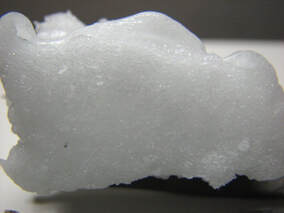
Rochelle salt crystals have been a popular crystal to make at home as they exhibit piezoelectric properties and are relatively easy to synthesize. Piezoelectric crystals generate a voltage when mechanically deformed, and conversely, deform when a voltage is applied. At one time they were used as a transducer in phonographs to generate the signal from a record and subsequently amplified to produce sound. They fell out of favor as newer technologies were developed and they also suffered from being deliquescent, and picked up water from any damp environment. There are many sites where the making and testing of these crystals can be found. Simply search for “Rochelle salt piezocrystals” and multiple entries will show up. For a really excellent site for not only Rochelle salt but other crystal growing, see Andrew Dominic Fortes' page here. I have been making these crystals since before there was an internet and recently began seeing a number of people having trouble with the process. Crystals were either not being produced or the color was very yellow among other concerns. I recognized the difficulty and I am posting this discussion to clear up some of the issues The reactants necessary to synthesize Rochelle salt, (potassium sodium tartrate), which is a double salt, involves the use of potassium bitartrate, also sold as “cream of tartar” in markets in the spice aisle, and sodium carbonate, also sold in the market in the detergent aisle as Borax washing soda. Baking soda, (sodium bicarbonate), can be used in place of the washing soda but involves heating to drive off water and CO2. It is much easier to just use the borax washing soda. The problem as I have seen it that the cream of tartar has a variable composition and may contain other chemicals to stop clumping, or other modifiers to make the product less expensive. This leads to at least two problems: The first is that the reaction is changed to produce unwanted byproducts, and the second is that the final crystals have inclusions which lead to poor crystal quality. The easy solution to the problem is to simply recrystallize the crude cream of tartar and then harvest the clean product for the synthesis of the Rochelle salt. Fortunately, cream of tartar is easy to recrystallize as it is much more soluble in hot water than cold, which is the perfect condition for clean crystals. See the lead photos. At 100 degrees centigrade, 100 ml of water will hold about 6.2 grams of cream of tartar. At 10 degrees, it will hold only about 0.6 grams. So here is the process to do the recrystallization: Place about 6 grams of the cream of tartar into a suitable container such as a Pyrex measuring cup. In a saucepan, bring a water bath up to just boiling and place the cream of tartar container in and immediately add about 100 ml's of distilled water. When the solution reaches just about boiling, stir to dissolve. Let as much dissolve as seems reasonable and filter through a coffee filter or filter paper. Let the clean solution cool to room temperature. The crystals will be forming at this point. Place in a refrigerator and let cool completely. Then, filter and collect the crystals and dry. That is really all that is necessary to now proceed to the synthesis of the Rochelle salt. Losses will vary but you can use the following formula to calculate recovery if desired: % Recovery = amount recovered divided by initial quantity X 100. Good luck!
Video Below:
This post covers two separate aspects of fire; color and shape. The flame color is determined by the fuel used, available oxygen, and the rate of combustion. The colors that we are most familiar with are generally blue, associated with propane, butane, and other gases, and yellow as with candles and other petrochemical sources. This is of course, a generalization, and we can see red and combinations of the base colors depending for example, on the composition of a candle wick. But, typically, we would not expect to see green. However, the color of flames can be changed by the simple addition of some salts of metals. Examples of this modification can be found in materials for homeowners to make their own colored flame logs for fireplace use. And, safety flares and fireworks also make use of the incorporation of metal salts to provide many different and spectacular colors. In chemistry, the well-known flame test can indicate the presence of many metals from the metal salts. The shape of a flame is typically controlled by air flow and how the air interacts with the emerging process of combustion. For example, if air is added to a flame under pressure as in a propane torch or Bunsen burner, we see a more focused and hotter flame. But normally, it is not typical to see flames assume the shape of a vortex. But, this does occur in nature in a fire tornado or fire whirl. Similar to a standard tornado, the air around a flame is circular and causes a vortex to form and move laterally. In this video this phenomena is demonstrated and is interesting to watch. In this experiment I am using boric acid (hydrogen borate) to provide the green color. Boric acid is used as an antiseptic, eye wash, and ant killer. It is available at drug stores and garden centers. The fuel is methyl alcohol, available as the gas line antifreeze, Heet. This is sold at auto stores and Walmart and is a clean burning fuel. Other alcohols may work as well and are available at drug stores as Isopropyl, and Ethyl alcohol. In this video I have used 1/4 cup Heet, and 1 teaspoon of boric acid for a 5 minute burn time. Neither the green fire or tornado experiments are original, but, I have not seen the two ideas combined and I think that the green fire is more visually interesting when viewed as a vortex. A search for "green fire", "fire tornado", and "flame test", will yield results showing other chemicals and their colors, and video of fire tornadoes. Please be safe when using fire and burning chemicals. If you cannot be safe, don;t do it! Enjoy the video:
|