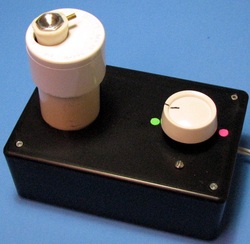
Testing the melting point of an organic compound is frequently used to qualify and quantify the purity of a chemical. Unfortunately, the cost of suitable equipment is quite high and out of reach of the home chemist. And, although I continue to make or isolate chemicals sourced through garden centers, hardware stores, and craft stores, I have never had a melting point apparatus for home use until now.
I had some thoughts about using the heating element from a hot glue gun when I posted the project on “Making Color Hot Glue Sticks” and the results are documented in the two videos below. And, although the precision of a homemade device is not as good as a $500 piece of equipment, the results have been very acceptable.
I determined the accuracy of the project by testing the melting point of three known standards that I had on hand that had a range of from 50C to 200C. These were reagent grade materials and I used a ramp speed of 10 degrees C per minute until melt occurred. In all three samples, the error was +2 C higher than the literature value. So, I can reduce the reading on the meter by 2 degrees and be fairly certain of the correct melting point.
Another tip for dealing with the variation in chemicals found in local retail locations can be to use recrystallization to purify these chemicals. I posted the recrystallization of potassium bitartrate (cream of tartar) found in the spice aisle of the supermarket to make better piezo crystals. The post is in the archive for December 2012, or scroll down to the post. Comments are always welcome and appreciated.
Electricity and heat = CAUTION...
I had some thoughts about using the heating element from a hot glue gun when I posted the project on “Making Color Hot Glue Sticks” and the results are documented in the two videos below. And, although the precision of a homemade device is not as good as a $500 piece of equipment, the results have been very acceptable.
I determined the accuracy of the project by testing the melting point of three known standards that I had on hand that had a range of from 50C to 200C. These were reagent grade materials and I used a ramp speed of 10 degrees C per minute until melt occurred. In all three samples, the error was +2 C higher than the literature value. So, I can reduce the reading on the meter by 2 degrees and be fairly certain of the correct melting point.
Another tip for dealing with the variation in chemicals found in local retail locations can be to use recrystallization to purify these chemicals. I posted the recrystallization of potassium bitartrate (cream of tartar) found in the spice aisle of the supermarket to make better piezo crystals. The post is in the archive for December 2012, or scroll down to the post. Comments are always welcome and appreciated.
Electricity and heat = CAUTION...
List of parts for this project:
Surebonder Hot Glue Gun 40 watt model H-270 High Temperature or equivalent.
Leviton Trimatron Single pole (1 Location) Rotary Dimmer 600 watts Number 705 or equivalent. Wired in as any other standard single pole switch.
Master Plumber soldering heat shield Fiberglas matting # 638 239 (9" X 12") or equivalent.
PVC pipe 4" long by 1 1/4" ID. (Schedule 40).
Machine bolt 2.5'' long by 7/16" diameter, 5/8" head Grade 5.
Surebonder Hot Glue Gun 40 watt model H-270 High Temperature or equivalent.
Leviton Trimatron Single pole (1 Location) Rotary Dimmer 600 watts Number 705 or equivalent. Wired in as any other standard single pole switch.
Master Plumber soldering heat shield Fiberglas matting # 638 239 (9" X 12") or equivalent.
PVC pipe 4" long by 1 1/4" ID. (Schedule 40).
Machine bolt 2.5'' long by 7/16" diameter, 5/8" head Grade 5.
 RSS Feed
